
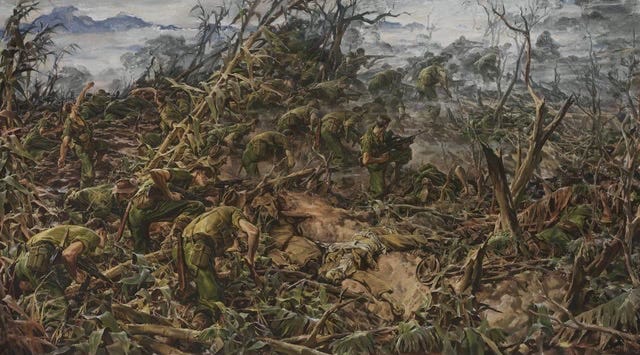

Recently, I had the opportunity to address a conference in Brisbane about how we might learn from Australia’s experience of the Pacific War between 1941 and 1945. For my talk, I focused on two key topics: the challenges and opportunities of national mobilisation and political leadership during the war, and how this can inform current political decision-making about national security.
Studying history allows for a better understanding of where our modern societies emerged from, and how their laws and values systems evolved. History can also reveal insights about how contemporary challenges might be resolved. For millennia, the study of military history has played this central role in the development of military leaders.
The Pacific War, among all of Australia’s conflicts, stands out for the direct threat that Australia faced, particularly in the early years of 1941 to 1943.
While the war in Europe resulted in Australia deploying land, air and sea forces, the war in the Pacific demanded the national mobilisation of every aspect of Australian society. This was driven not only by the bombing of Australian territory and the proximity of the enemy threat, but also by the first, large scale deployment of foreign forces to Australia and the need to support those forces.
Thus, Australia’s war in the Pacific provides a unique learning opportunity that can inform how modern politicians, and military leaders might face contemporary threats to Australia’s national security.
In my presentation, I will examine two elements of a nation’s higher command of its war fighting capacity: mobilisation and political leadership. Both are crucial in building and sustaining a war effort. In examining these subjects, I will link Australia’s experience of the Pacific War to modern national security concerns.

The term ‘mobilisation’ can be an emotional one, particularly for Western politicians who must balance diplomatic relationships, domestic populations more focussed on prosperity and inflation control than national security, as well as achieving a sustainable approach to budgeting. There are also many democratic societies (Sweden and Finland are outliers here) that are resistant to young people being forced to serve their nation.
But mobilising one’s national capacity is a vital concern in war, and that is exactly what the Australian nation did during the Pacific War. By 1943, our nation was one that was implementing almost total mobilisation for war. As a percentage of national income, the defence and war expenditure rose from 11 per cent in 1940-41 to 29 per cent in 1941-42 and to 43 per cent in 1942-43.
In doing so, Australia massively expanded its military capacity. But mobilisation is more than expanding the military. Mobilisation will be a trinity of national, not military, endeavours. The three elements are: industry; people; and ideas.
Industrial Mobilisation. By the middle of 1943, the number of government factories in Australia had grown by an order of magnitude. Nearly 40 different factories produced munitions and small arms. Many others were building small, mechanised vehicles such as the Bren Gun carrier, weapons optics, machine tools, as well as small ships and radar. Additionally, during the Second World War, Australia produced over 3500 aircraft.
As the official histories of Australia’s participation in the war note, the ruthless appropriation of materials and labour involved in all this direct war production threatened the stability of the non-military production in Australia. Some industries, especially those concerned with the supply of such raw materials as steel, expanded under the stimulus of war; some —the primary industries, for example—suffered heavy losses of manpower; while others —unessential or luxury industries—found they had no place in total war.
But in the modern world, there is limited capacity for producing large quantities of munitions or defence equipment in Australia, like most western nations. And while some munitions production is beginning to expand in Australia and other countries, many other elements of defence production must do the same. Military vehicles, as well as missiles, ships and aircraft all have long lead times to build and are produced (if they are in production) in small lots. Expanding production is expensive and takes time.
Fortunately, some newer technologies do not require the massive levels of investment in large factories or long lead time sub-components. Many types of drones are currently being manufactured in mass quantities at much lower prices than other conventional weapons. But to expand drone production, there must be a demand signal from governments and military institutions for thousands of units per year. Ukraine has achieved this, and it is currently producing around 2 million of drones per year.
But this is not the situation in most western nations.
Industrial mobilisation in many countries might also be improved and accelerated with more distributed forms of manufacturing, underpinned by advances in robotic assembly and additive manufacturing. As T.X. Hammes writes about changes in the manufacturing landscape:
Additive manufacturing is dramatically increasing the complexity of objects it can produce while simultaneously improving speed and precision.
Mobilising the Population. As we learned in the Pacific War, small professional military organisations are rarely up to the challenge of large, industrial wars. Australia had to expand to a very large force from a population of just 7 million, while balancing the demands of military and industrial requirements. Eventually, over 550,000 Australian service personnel served overseas.
But balancing civil and military priorities for manpower from 1943 onwards was a very tricky, political balancing act. We must learn from this.
Modern all-volunteer force models, adopted by many western nations in the past half century, are increasingly unreliable ways of ensuring adequate numbers of military personnel. This is posing significant challenges to the readiness and size of military institutions in the United States, Britain, Australia and elsewhere.
The inability to fill volunteer quotas has a flow on effect with military units running at lower personnel levels, which in turn impacts capability, readiness and sustainability. The concept of mobilisation becomes crucial in such an environment because it may provide the foundations for a different approach to securing sufficient soldiers, sailors, airmen and women for the military forces of democratic nations. Western nations will probably have to consider mixed forms of military service which include volunteer, reserve and national service personnel if they are to build the forces with the mass, and more importantly, array of different skill sets required in modern military forces.
Another aspect of mobilising people is addressing the current exquisite approaches to military training and education. Many nations have small, highly professionalised military institutions which put their people through exquisite training regimes which consume a lot of time. It is likely that these approaches are not survivable in an environment where mixed service categories may be required, time is limited, or where they may be a need to significantly expand the size of military forces. Shorter training regimes are required for an expanding force and these regimes must be focussed on the absolute basics needed for operational service.
Mobilising the people will also require mobilising academia. We did this during the Pacific War, either harnessing existing scientific capacity or building new industries such as aircraft, radar, optical systems and chemical weapons production. The scientific effort undertaken here during the Pacific War laid the foundations for our post-war national research and development capabilities as is described in David Mellor’s excellent official history of the role of science in Australia’s Pacific War.

There are already many examples where military-academia collaboration is occurring in countries such as Australia, Britain, Sweden, Canada and others. But more can be done. This must be a collaborative effort between military and academics to exploit the centuries of knowledge possessed by universities. In doing so, nations can enhance the intellectual armour of military leaders in a more lethal, complex and ambiguous environment.
The 2022 Russian partial mobilisation challenges, and Ukraine’s ongoing challenges with recruiting, provides additional insights into mobilising people. Just as industry needs to build new factories in any mobilization of defence production, military services must build their training workforce if they are to have any hope of effectively expanding the size of military forces when called to do so.
Australia must learn from this lesson and ensure that there is a peacetime expansion of an instructor workforce, and the supporting physical infrastructure such as base accommodation and training ranges, that is critical to any mobilization of personnel. But, as these changes are implemented, new and evolving ideas about warfighting and military affairs will also be required. This is the third and final element of a 21st century national mobilisation concept. (See one of my articles on mobilisation published by Engelsberg Ideas here).

Mobilising New Warfighting Ideas. One of Australia’s great advantages in the Pacific War was that it was a young nation, and its military was still relatively unformed. Despite its experience on the western front, the Australian military demonstrated a willingness to invent new forms of doing business as they became more acclimatised to the Pacific environment, the enemy and their American allies from 1942 onwards.
In 21st century mobilisation, nations must be able to leverage their best minds as individuals and in collectives to develop solutions to military and national defence problems, implement them effectively and to learn and adapt as events transpire.
An important element of this is building an improved understanding of current and potential adversaries. Of course, this is often associated with intelligence and during the Pacific War, we built a well-earned reputation for this field, particularly in using our coast watchers and our nascent electronic warfare capability in partnership with America.
During the Pacific War, Australia also built a sophisticated operational research capability, and undertook world-class research in camouflage, deception and the full array of tropic-proofing needs required by our troops. Lessons collection, distribution and conversion into new capability is a strategic priority in military affairs. More robust studies of current adversaries and operating environments for our troops will be central to any development of evolved or new warfighting concepts.
Just as Australian soldiers and airmen learnt to collaborate better in places such as New Guinea, several recent developments will have an influence on new warfighting ideas. The expansion in autonomous systems across all domains is having a profound impact, particularly on tactical operations in the ground and maritime environments. They are also beginning to have an impact in longer range strike complexes as well as on air defence environments. More importantly, as the number of these systems increases, they challenge military organisations to rethink old ideas about military structures.
This is likely to force changes in military organisations at least as consequential as the formation of air forces in the 20th century. It is likely to result in a shift in the ratio of humans and autonomous systems across the deep, close and rear operations of military endeavours. As this ratio of humans to autonomous, quasi-intelligent machines shifts, so too must leadership, training and education regimes evolve.
Contemporary military training and education systems are founded on humans using machines, but there must be a shift to a training culture, with humans partnering with machines and algorithms. This will drive a major change in the culture of military organisations.
Mobilising national capacity is not just about building the ability to fight a war. It is also a means of deterring war. A nation that undertakes even limited mobilisation of its resources, or has feasible plans to mobilise them quickly, is telegraphing saying to potential aggressors that “we are ready, don’t try anything today”. It is also an important statement of national will. While even a partial mobilisation for military purposes can be expensive, it may be much cheaper than having to fight because we failed to sufficiently invest in deterring aggression.
The Pacific War, and many wars since, provide us with invaluable insights into the imperative for good political leadership. While that might be hard to imagine in the current era, it is still necessary that we aspire to the best political leaders possible.
The first lesson is about the importance of alliances. The relationship between Australian Prime Minister John Curtin and General Douglas MacArthur was a crucial and generally workable civil-military relationship during the immediate threat of Japanese invasion in 1942. Curtin placed Australian forces under MacArthur’s command as the Supreme Commander of the South-West Pacific Area, a move seen as a necessary surrender of sovereignty to secure Australia’s defence and resources.
Modern political leaders must not only understand the importance of alliances in the security of their nations, but how these alliances contribute to a more secure and prosperous global security environment. Political leaders must appreciate the necessity of investing in such alliances and be advocates for them with both domestic and international audiences.

A second lesson on political leadership from the war might be about the pace of decision-making. In the wake of the fall of Singapore, John Curtin had to make some relatively fast decisions. The need for speed is even more compelling now. The speed of planning, decision making and action is increasing due to hypersonic weapons, faster media cycles, and AI support at many levels. Military organisations must ensure that their people and institutions at every level are able to intellectually and physically deal with the environment through better use of time for improved decision-making.
Further, military personnel must be able to exploit this use of time to improve their capacity to adapt through re-organisation, re-equipping, re-thinking and re-skilling. This exploitation of time also applies to politicians. And, it might be observed, that politicians have not adapted well to the pace of modern war. Australian political decision-making about the provision of military assistance to Ukraine has been much slower and more parsimonious than required by battlefield and strategic realities.
A third lesson for political leaders is about strategic communication with their citizens and enemy populations. Just as Curtin gave frequent speeches to inform the Australian people about developments in the war, and sustain a cohesive nation, we must be able to do so today. Disruptive new technologies have not only enhanced the lethality of military forces at greater distances, but they also now provide the technological means to target and influence various populations in a way that has not been possible before.
Political leaders need to be able to explain conflict to their citizens, and the strategies and resources needed to defend national sovereignty. At the same time, the political leaders of democratic nations must be able to make hard decisions about strategic influence operations that are aimed at the populations of enemy states – and defending against enemy misinformation operations.
A fourth lesson is about the possibility of war. In his book, The Causes of War, Geoffrey Blainey writes of General Thomas Blamey in November 1941 deploring Australia’s lack of consciousness about a potential war in the Pacific. On his return from the Middle East, Blamey stated that: “I am astounded by the complacency with which the people in Australia view the war situation. You are leading a carnival life, and you are enjoying it. Australians are like a herd of gazelles on the grassy edge of the jungle.”
Not much has changed. Contemporary political cultures in western nations are not well informed about war and its consequences. The past thirty years, described by some as the long peace, has seen the Cold War generation of political leaders and staffers move on and be replaced by a new generation. This new generation, seduced by the economic growth and increased globalisation have largely come to believe that large-scale war in the Pacific is not possible in the 21st century, regardless of the lessons of Ukraine.
A final lesson for political leaders from the Pacific War is about will.
The key lesson is that no one will help a nation that doesn’t demonstrate the will to defend itself. Australia stepped up to the challenge between 1941 and 1945. This is an essential lesson about will, and one that politicians everywhere today must learn. There are many dimensions to this demonstration of will. Ultimately it is about building national resilience in all its forms.
The level of complacency in modern Australia, and governments unwillingness to tackle such complacency, provides few insights into whether we possess the will to defend ourselves in the modern era. This year’s Lowy Poll found that just 52% of Australians surveyed answered with an unequivocal “yes” when asked if they would defend Australia.

One-quarter (24%) say they would not, while the remainder (25%) say they don’t know or are not sure.
The loathing of Australia demonstrated by some elements of our population, including those Australians who attended the Beijing Parade last week, would probably be a foreign concept for that amazing generation of Australians that helped win the Pacific War.
Given the array of security challenges presented by China, Russia and North Korea for Pacific nations at present, we cannot afford to discard the lessons of the war in the Pacific. A war that spanned a far larger proportion of the earth’s surface than the war in Europe, the Pacific War provides many different insights into strategy, industrial mobilisation and leadership for modern leaders.
In his volume of the official history of Australia in the Second World War, Paul Hasluck wrote that:
Among the deeply emotional experiences of war was also fear. Some Australians had talked for many years about the peril of invasion from Asia. Now all Australians had seen that it might really take place. More of them than ever before had learnt how precarious is the life of a nation. Many of them glimpsed for the first time in the history of their land the possibility of occupation by an enemy and subjection to alien rule and they learnt that the independence and the defence of an island continent cannot be taken for granted. Only experience will show how long the influence of wartime emotion will last.
And that is the real question for us today.
Has Australia retained its experience of war as a nation from 1941 to 1945? If not, what might be the cost at the start of the next war because of this national amnesia?
link