
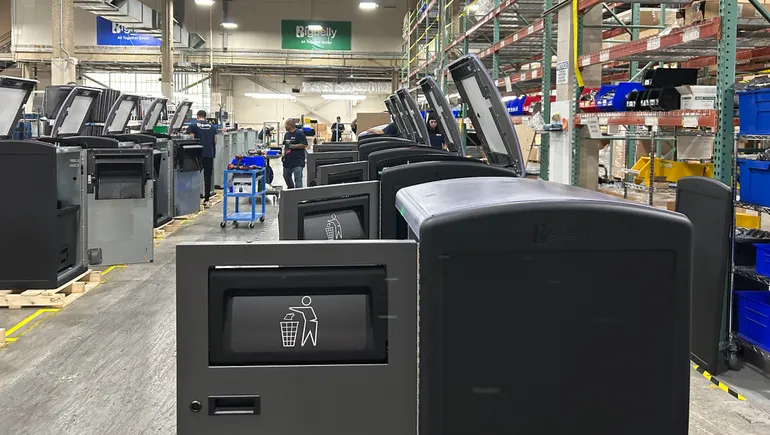
Years before tariffs kicked in, Massachusetts-based Bigbelly decided it was time to shift production of its waste and recycling bins back to the United States. Now, two years into reshoring, the company has nearly doubled the output of its assembly operations to upward of 45 units per day to meet growing customer demand.
The company’s range of public space bins, including some with solar-powered compaction and data capabilities, are increasingly ubiquitous around the world. Bigbellies are commonly found on street corners, parks, schools, airports, venues and other locations in major cities such as New York and Philadelphia.
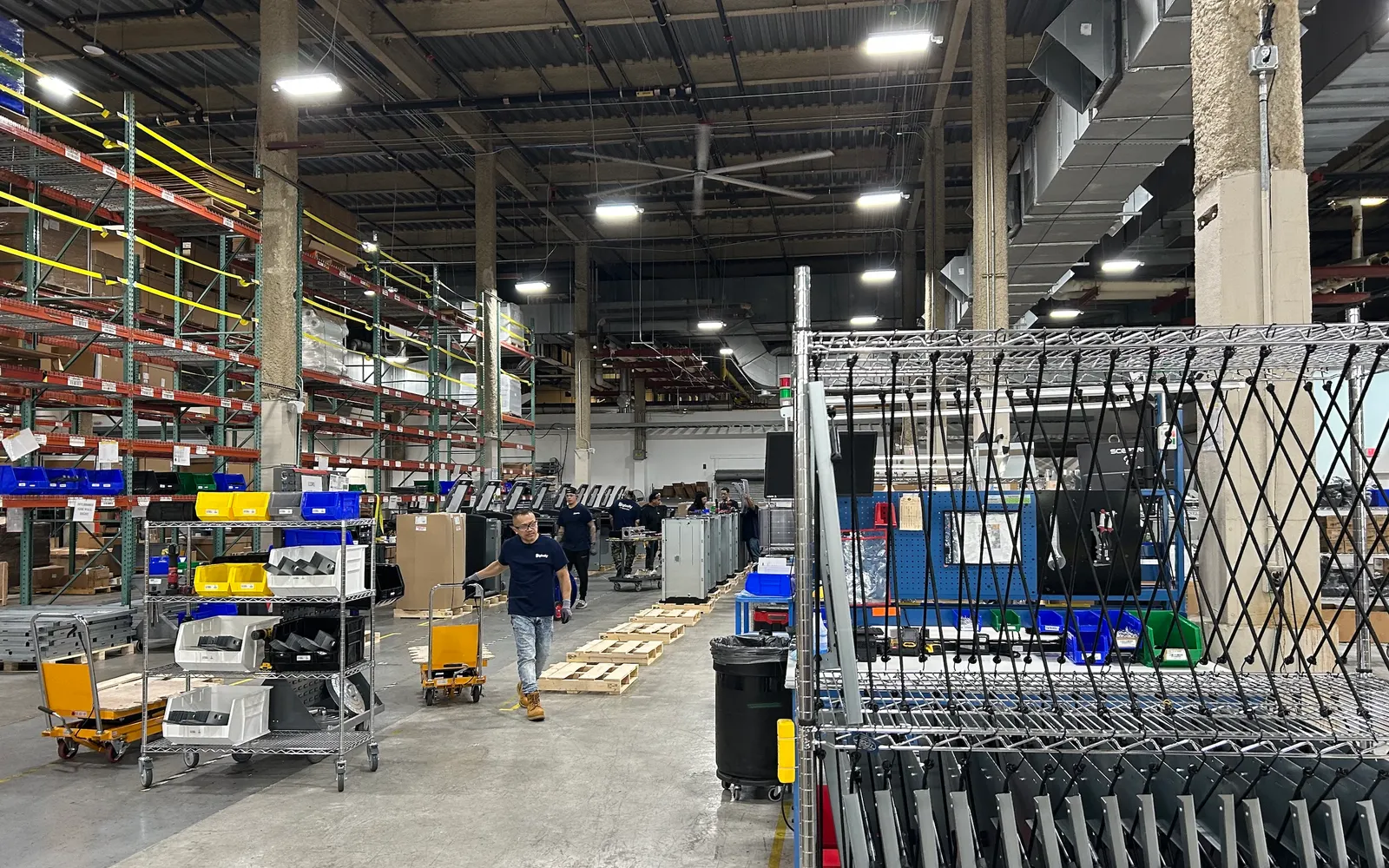
Bigbelly previously shifted its assembly operations to Mexico, but decided to change course and launched its new facility in Massachusetts’ Merrimack Valley in 2023. The facility, located at the IndusPad campus directly on the border of Lawrence and Methuen, was previously used by fleece company Polartec.
The company said this shift has been well worth the investment to give it greater oversight of the production process. Bigbelly previously worked with contract manufacturers, but found the relationships ended up resetting every few years because its product uses many custom parts.
“We were in Mexico because that’s where the contract manufacturer wanted our product to be made,” said President Brian Phillips during a June interview. “There’s very little stuff in the Bigbelly that they can buy and use on anything else they make.”
“A lot of those contract manufacturers are really set up to make things like circuit boards and things that there’s a lot of commonality with componentry that they can use on one product to another.”
The company now also has more control over configuration and product changes, which leaders say makes for more efficient operations. The IndusPad site was chosen in part because of its proximity to Bigbelly’s headquarters and engineering office in Needham.
“The link between engineering and manufacturing is much better,” said Plant Manager Michael Sampou.
Assembly line
The former Polartec facility required some changes, such as getting rid of drying troughs in the floor, but came with ample space and access to more than 20 loading docks.
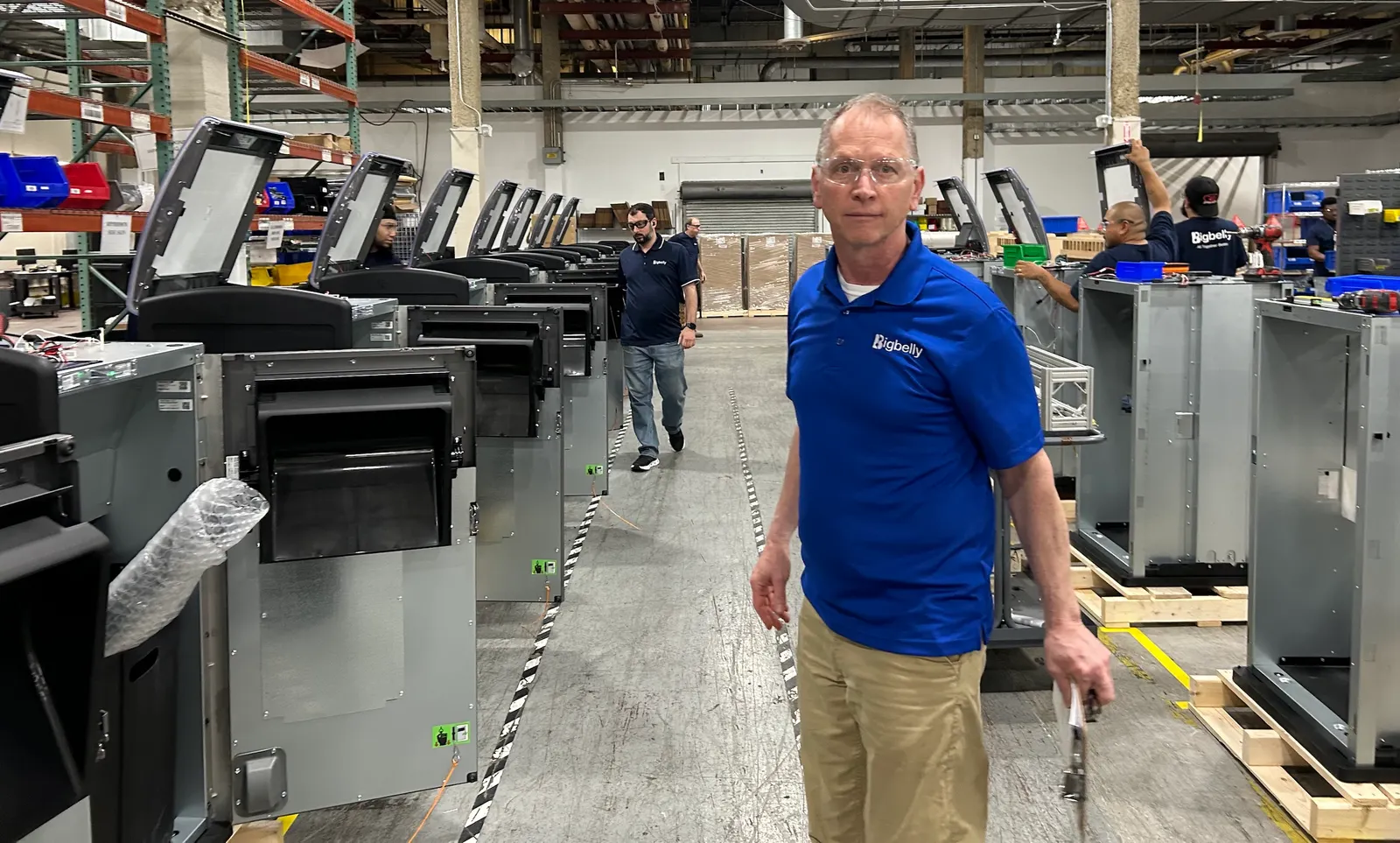
Bigbelly Plant Manager Michael Sampou leads a tour of the company’s assembly operations.
Cole Rosengren/Manufacturing Dive
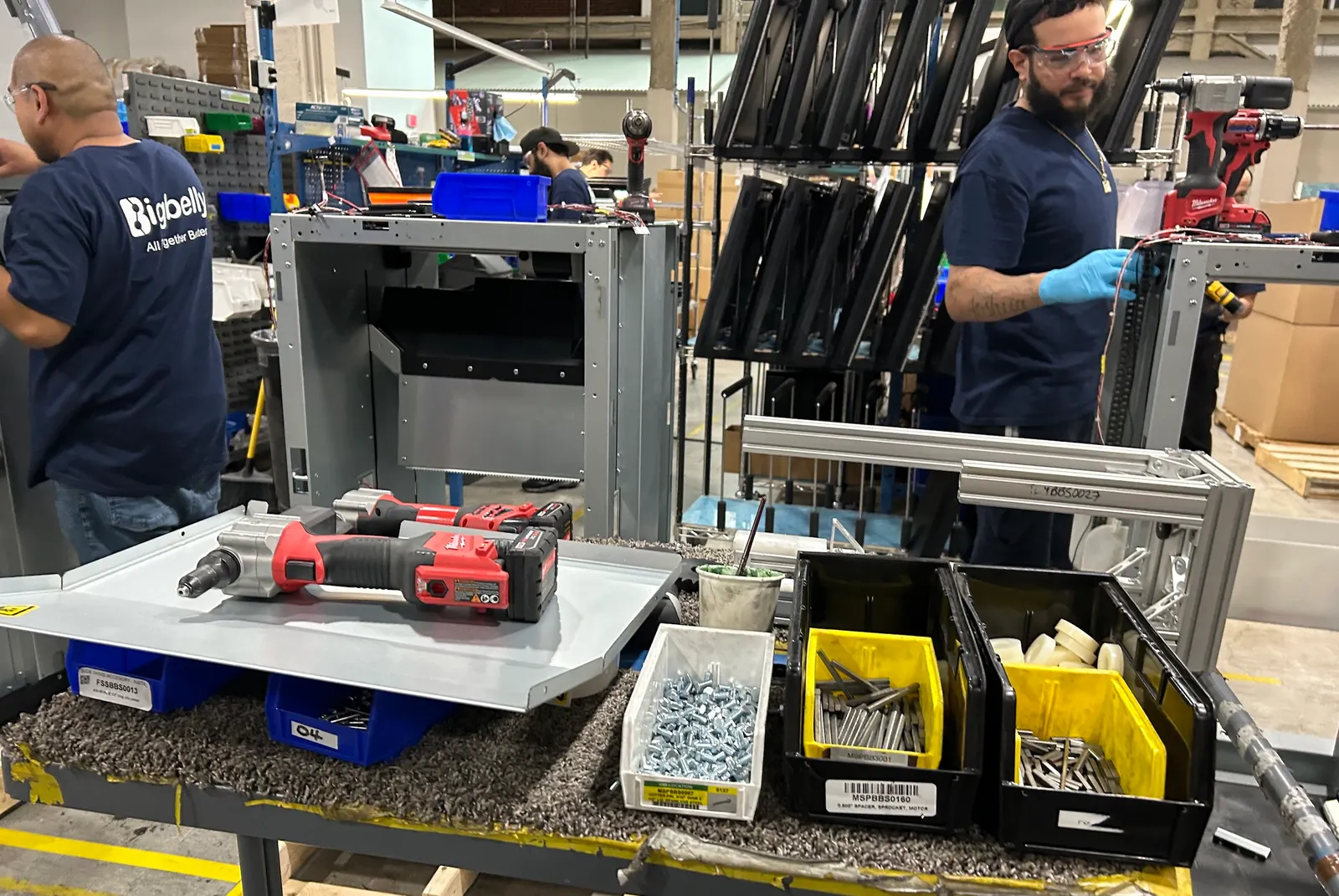
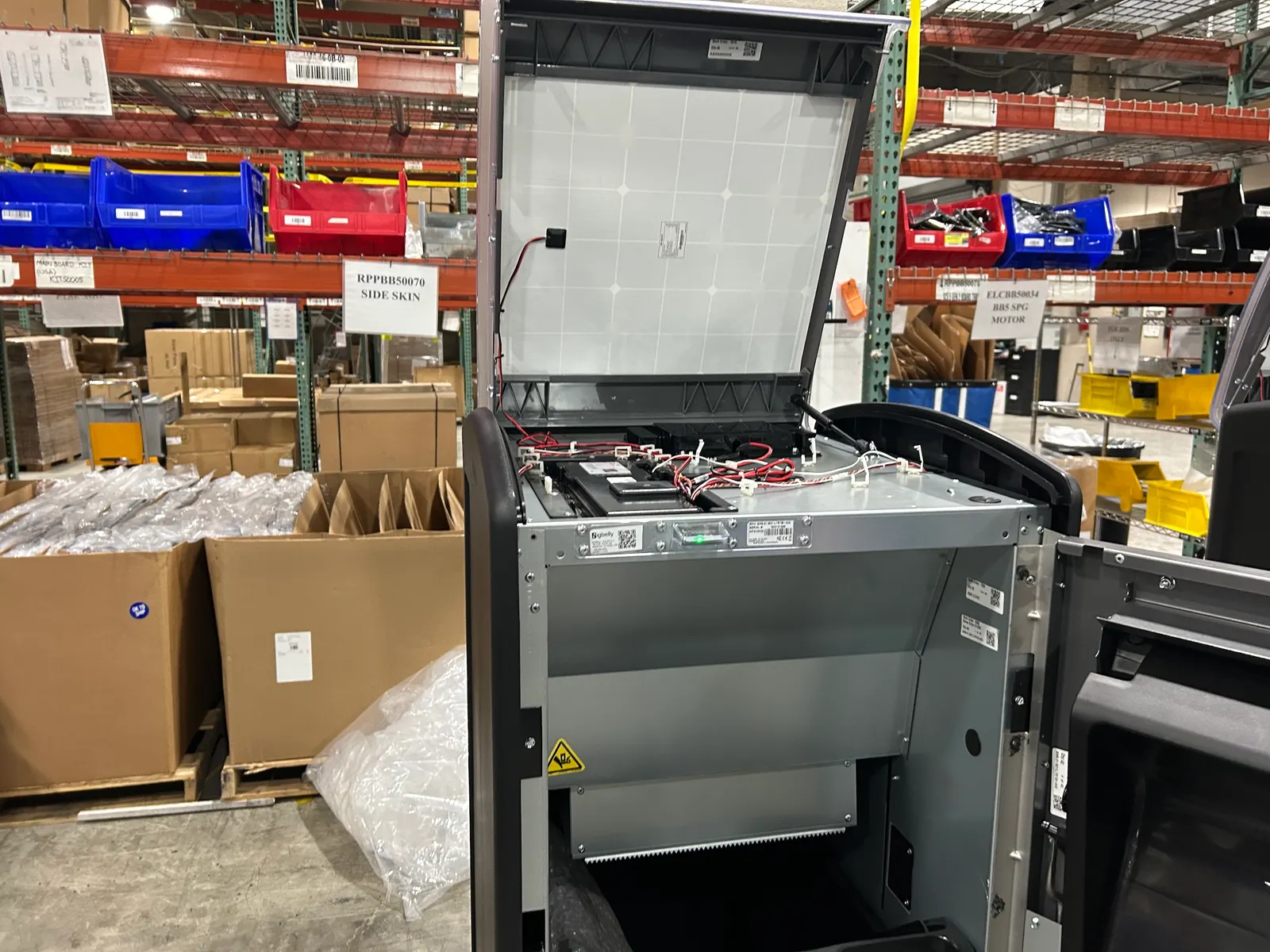
Bigbelly is currently running one assembly shift per day. Sampou manages a 20-person team that uses electric drills, riveters and other tools to assemble waste and recycling bins. Aside from investing in custom-designed dollies to move the products around, the process is relatively manual. Simpler units can take about an hour to assemble, whereas the more complex ones with motors, solar panels and additional electronic components could take three hours.
The company currently employs over 65 people in the state, including its assembly team. It is continuously working to recruit and retain assembly employees, with competition from other manufacturing sectors in the region such as semiconductors, defense, pharmaceuticals and medical devices.
Cole Rosengren/Manufacturing Dive
Bigbelly works with veterans groups, state agencies, the Merrimack Valley Chamber of Commerce and others on hiring events. The company aims to find people with assembly experience, but can train others. Its training process, which starts with subassembly tasks, takes about three months.
Bigbelly’s shift back to domestic production comes with benefits, but hasn’t totally insulated it from supply chain complexities for various components in recent years. The company said it has good supplier relationships and works to maintain a parts inventory at a nearby warehouse.
“When the world’s working the way it should be, none of this stuff’s hard to get. We’re not making anything that’s super crazy, special, high-tech. We’re making sheet metal. We’re doing plastic with generally available resin,” said Jeff Satwicz, co-founder and vice president of product development.
Despite the shift to domestic production, tariffs have also affected the company. Bigbelly has seen costs increase by approximately 9% this year as a result.
“We made a strategic decision to limit our U.S. price adjustment to just 4%, in an effort to support our customers and absorb part of the cost impact ourselves,” said Michelle Firmbauch Nadeau, director of marketing, via email.
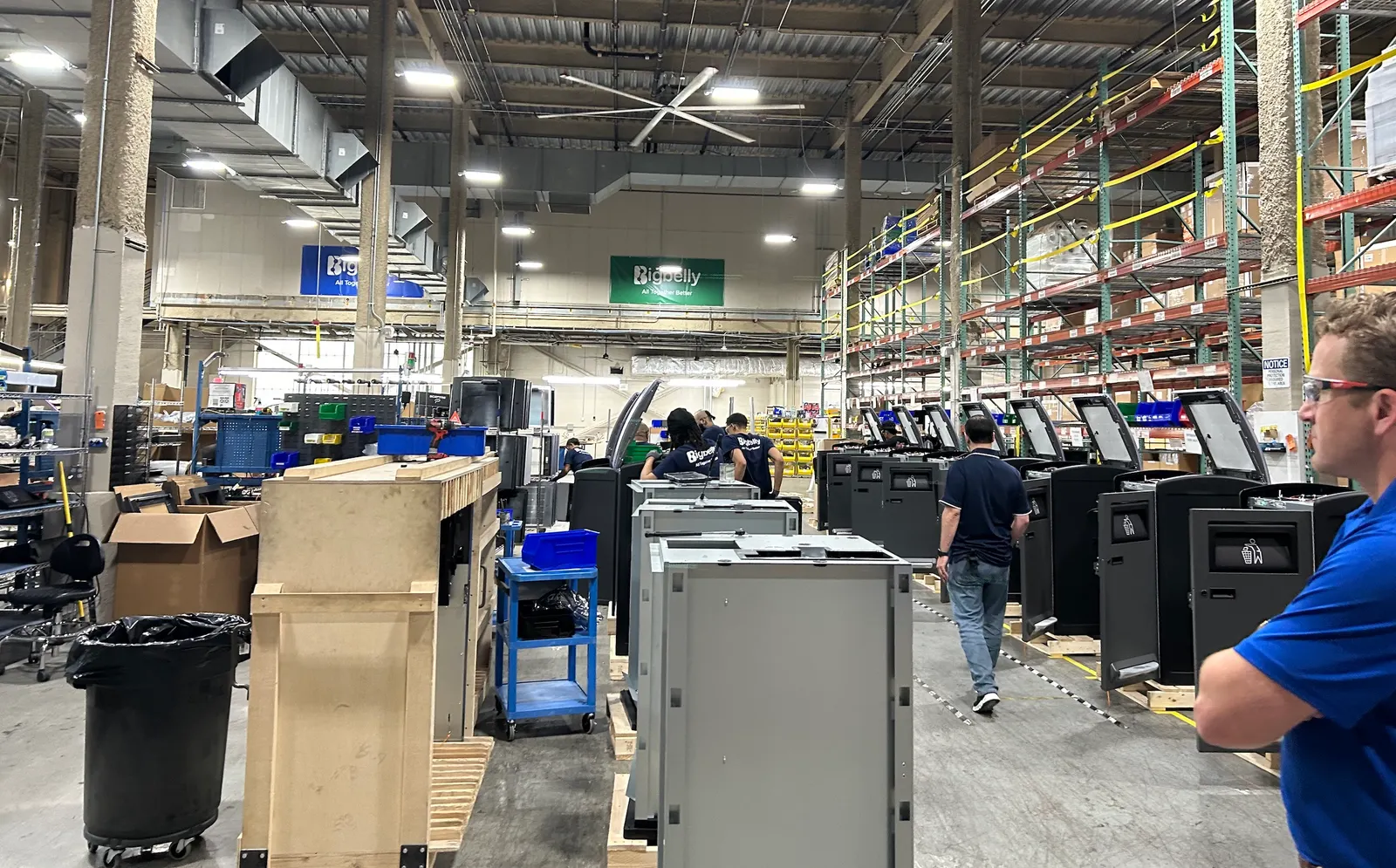
Bigbelly cofounder Jeff Satwicz, right, stands in the company’s Massachusetts assembly facility on June 18, 2025.
Cole Rosengren/Manufacturing Dive
Product evolution
Bigbelly started in 2003 as a project among college friends, including Satwicz, and has now scaled to become one of the more well-known brands in public space waste and recycling bins with customers in 65 countries.
“We kind of fell into waste containment and accidentally started the company making a solar compactor,” said Satwicz, adding that waste enclosure became their focus as they worked to design a unit that avoided humans or animals interfering with the compactor.
Bigbelly offerings evolved to include what the company calls its first “smart bin” in 2009, allowing customers to get alerts about fullness levels and usage, and have expanded since. This recent growth was fueled in part by Bigbelly becoming a portfolio company of private equity firm McCarthy Capital in 2019. The company has also grown via financing from Cambridge Savings Bank and the Massachusetts Green Energy Fund, according to Crunchbase.
Cole Rosengren/Manufacturing Dive
A few years back, Bigbelly hired an outside firm to survey 100 of its clients about why they used the product. An estimated 80% said they initially were drawn by the compaction feature, but the main benefit had been waste containment. They cited benefits such as pest deterrence, litter reduction and cleaner public spaces.
This led Bigbelly to expand its product offerings in 2023. Today, its options start with the Element that has no “smart” features and is priced to compete with standard wire baskets at $1,600. The highest end product is the solar-powered and data-enabled Smart Max, which can cost $4,800 when including a multiyear software package.
The company has an estimated 3,700 active customers around the world, including many local governments that purchase units with infusions from municipal budgets or one-time grants that must be spent within shorter timeframes.
“You can’t do most capital projects. You can’t build bridges in that amount of time. You can’t do roads in that amount of time. But you can put in Bigbellies,” Satwicz said.
Local perspective
Bigbelly competes with a variety of other public space waste and recycling enclosure providers, but has managed to secure a foothold with many major local government clients.
Philadelphia is among the company’s earliest and most active municipal clients with thousands of units purchased in recent years. The city started buying them in 2007, with a focus on downtown business corridors. Last year, Philadelphia moved to double that scale with funding from the city’s Office of Clean and Green Intiatives.
“We are installing Bigbellies in places and in communities where they’ve never seen a Bigbelly outside of Center City,” said Sanitation Commissioner Crystal Jacobs Shipman, citing benefits over open wire baskets. “[It] provides a solution for us in a big city that is dealing with a lot of challenges related to litter, illegal dumping and just the nature of being in a city with a heavy transit population.”
The new bins will be going to other business areas in smaller neighborhoods, as well as schools in some cases. Shipman also said the city is looking at piloting Bigbelly’s “smart compost” bins, which launched last year.
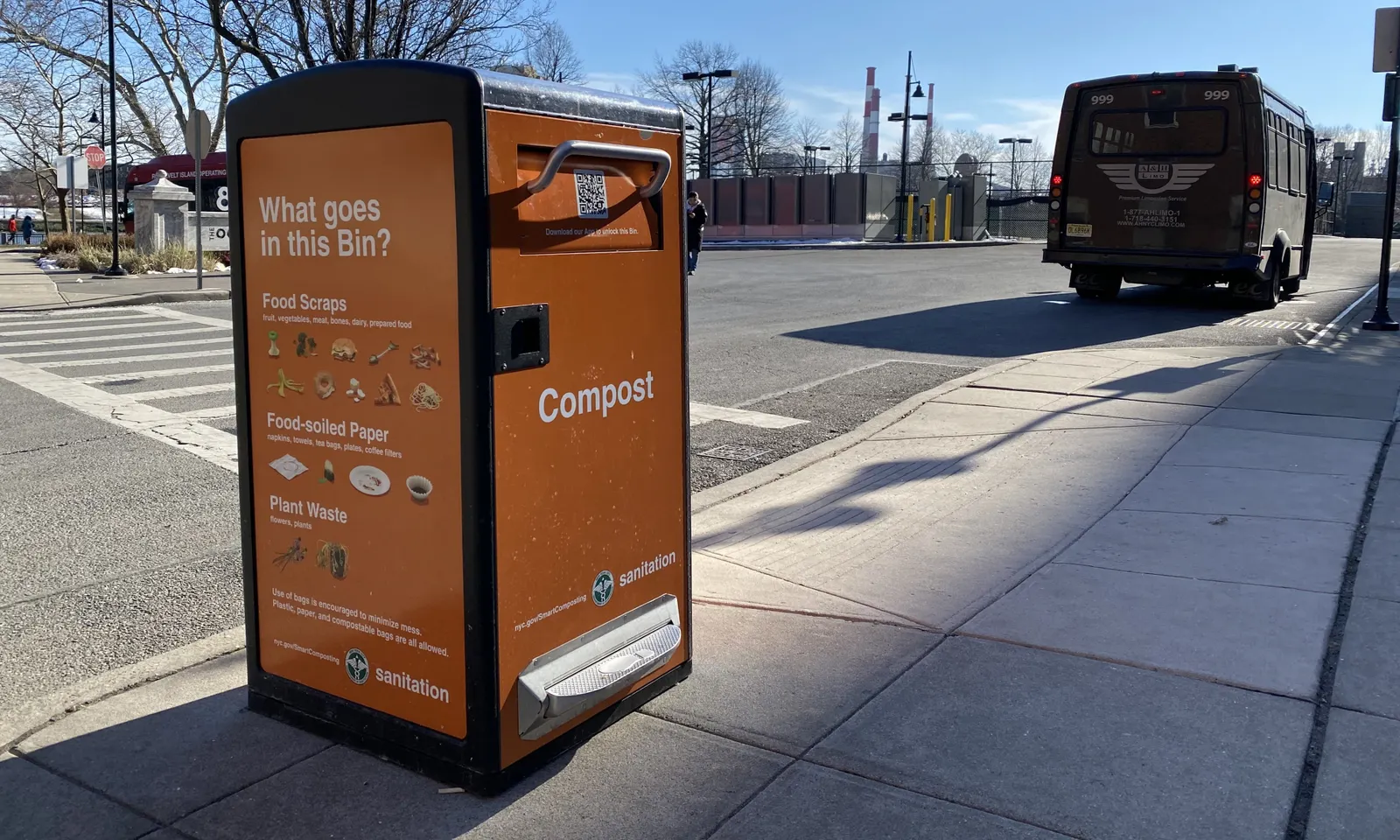
Bigbelly launched organics drop-off bins in 2024, which have since been adopted in cities such as New York.
Jacob Wallace/Manufacturing Dive
New York City has an estimated 4,500 Bigbelly units in total, spread out over about 40 different accounts.
The city’s Department of Sanitation has installed an estimated 400 organics drop-off bins, which residents can unlock via a phone app. The bins have been unlocked more than 2.6 million times, including more than 500,000 times this year, according to the agency. Press Secretary Vincent Gragniani said the bins “have proven to be incredibly popular” as another way to divert organics from disposal.
Somerville, Massachusetts, recently used funding from a citizen-led participatory budgeting process to place more bins in parks. The city has also focused on placing more of the units outside of school buildings, in part to help with rodent control.
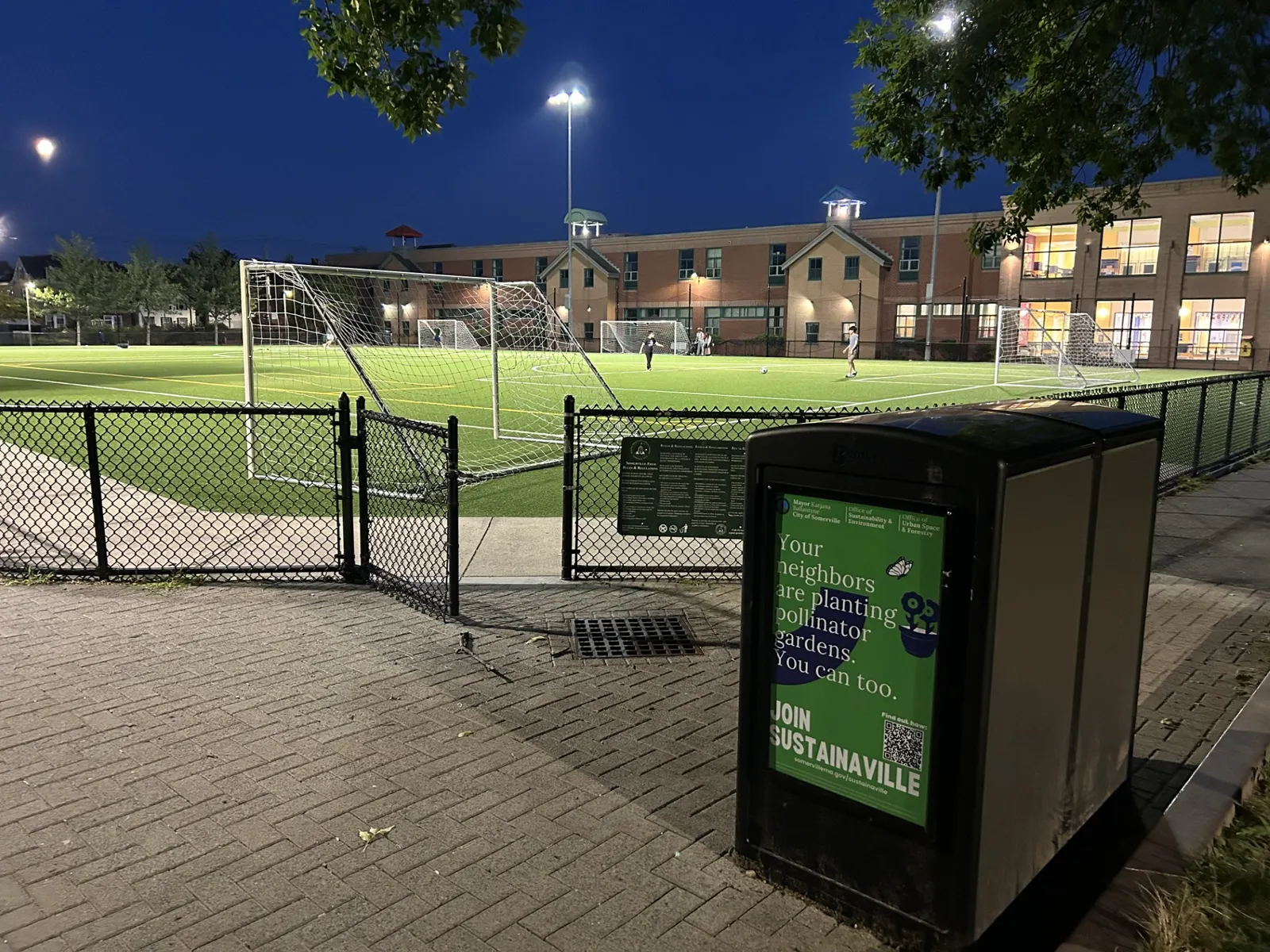
A pair of Bigbelly bins were recently installed at Glen Park in Somerville, Mass. The city has increased its placement of Bigbelly units near schools and in parks.
Cole Rosengren/Manufacturing Dive
Department of Public Works Commissioner Jill Lathan said the city has scaled its investment in the units due to positive feedback from residents and good customer service from the company. Lathan said this has led to benefits in terms of limiting illegal dumping and improving collection efficiency.
“I think operationally that’s probably the biggest plus for us,” said Lathan, “especially for some areas.”
“Some squares that have heavy use, the open barrels could be filled up within a few hours and that would mean assigning additional staff that you may or may not have the capacity to do.”
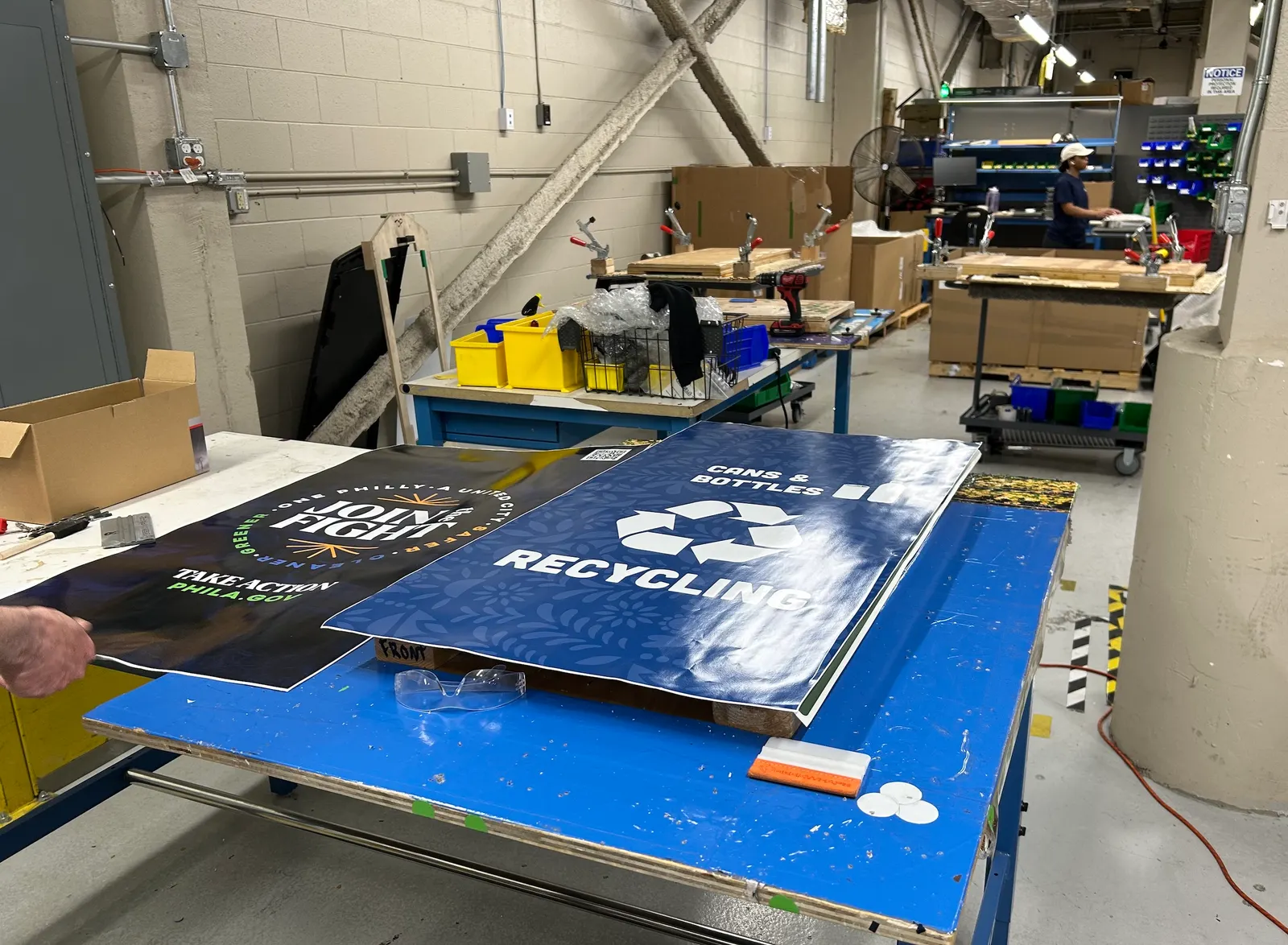
Bigbelly units can last an estimated 10 to 15 years, and the company said they can be recycled after. Bigbelly customers have the option to pay for regular maintenance services or handle it themselves. In Somerville’s case, Lathan said the city has done a mix of both. The bins also offer an opportunity for custom signage and wraps.
Cole Rosengren/Manufacturing Dive
Philadelphia has its own dedicated team of six people that go out to repair and replace damaged bins around the city. Shipman said this team’s creation predated her time as commissioner, but she sees benefits of keeping the work in house because it creates well-paying city jobs and “we have a lot more flexibility on how quickly they can respond.”
Looking ahead
Bigbelly sees plenty of future growth potential, driven in part by rodent, cleanliness and sustainability concerns among its clients. The company is increasingly focused on expanding into markets such as airports, truck stops, entertainment venues and universities.
Local governments or city organizations remain a key customer base, including many that want more ways to track sustainability data and optimize operations. Bigbelly’s Phillips said in some cases crews will use the app to plan their routing and get ahead of overflows. Bigbelly’s tech-enabled units can alert customers when their 150-gallon bins are 60% full.
Some municipalities don’t rely on the data as much, but still view it as valuable.
“It’s great to have, and you want that in your system,” said Somerville’s Lathan, “but I don’t know at this point if it’s really changed our operations.”
Philadelphia’s Shipman also said the data is useful to have but doesn’t lead to regular route changes.
”We follow pretty standard routes for collecting the units, regardless of their capacity, regardless of whether or not they’re full. But when we get an alert that a unit is at 80% capacity … then we know we may have to pay a special trip to this unit.”
Existing clients such as Newton, Massachusetts, have sometimes adjusted their bin placement based on years of usage data, and many others have also used the data to change their collection plans. According to Bigbelly, some customers may see up to an 80% reduction in collection frequency.
The Downtown Alliance, a business group which serves Lower Manhattan in New York City, used to average 27 pickups per week with its old bins and is now down to three. The Times Square Alliance went from an average of 28 per week to 12.
Over time, the company also sees potential for customers and itself to gain even more insight from Bigbelly’s proprietary Clean software. This could scale even further due to the capabilities of artificial intelligence.
“We’ve been dreaming a lot about where this is going to go … with AI,” said Phillips, “because the one thing this thing knows is it knows the history of trash, what the waste flow volume that’s been going in those bins over time is throughout the year.”
Cole Rosengren/Manufacturing Dive
Bigbelly’s engineering team is continuously following these technology trends as they look at updated or new product offerings.
Over time, the company aims to produce 50 units per day at its Merrimack Valley facility. And eventually it could grow to two or three shifts.
“We’re trying to work on ideas to speed up production, making sure we can scale up here well,” said Satwicz. “We feel like this is the facility that will support us for a long, long time to come.”
link