

Seismic changes are taking place in Europe. Prompted by signs that the
traditional U.S. security support could be withdrawn or at least
downsized, the German parliament recently passed landmark fiscal stimulus
measures, a move which had eluded generations of lawmakers. The country is
now poised to enter a new phase, in our view, moving beyond a period in
which fiscal constraints stifled growth and undermined competitiveness.
The German fiscal package relaxes the limitation on structural deficits to
allow for higher defense spending, a measure that effectively leaves
defense spending unconstrained. It also creates a special fund for
infrastructure investments of as much as €500 billion (or a sizeable
12 percent of annual GDP) over the next 12 years. Transport, hospitals and
care, energy, education, digitization, and R&D are all targeted.
It is notable that these measures were championed by chancellor-to-be
Friedrich Merz, leader of the CDU/CSU party, who had recently campaigned
on preserving fiscal restraint. His significant pivot points to the
seriousness of both the situation and the commitment.
Meanwhile, the European Commission has proposed a plan to address
deficiencies in the region’s defense capabilities by 2030, with
recommended funding of up to €800 billion. This includes €150 billion of
joint EU loans for defense investment and making defense spending by
member states exempt from the bloc’s deficit rules.
Joint debt issuance has long been a contentious issue within the EU, and
historically has been reserved for times of crisis such as the COVID-19
pandemic. Wealthier northern member states have been reluctant to
subsidize their less-affluent neighbors, making such measures politically
sensitive. The fact that joint issuance is once again being considered
underscores the urgency of the current situation and suggests willingness
to strengthen financial unity within the bloc may be growing. European
Union leaders will now seek approval for the plan in their own countries.
Improving economic prospects
These changes are occurring as the region’s domestic economy is picking
up. RBC Capital Markets economists point out that real incomes have grown
modestly as inflation has subsided. This and the delayed pass-through of
the European Central Bank’s (ECB) cuts to outstanding mortgage rates
should underpin a revival of consumption.
Economic activity indicators such as the HCOB Eurozone Composite
Purchasing Managers’ Index are now narrowly in expansion territory.
The underlying European economy is running above long-term average growth
rates
Contributors to European Union GDP growth
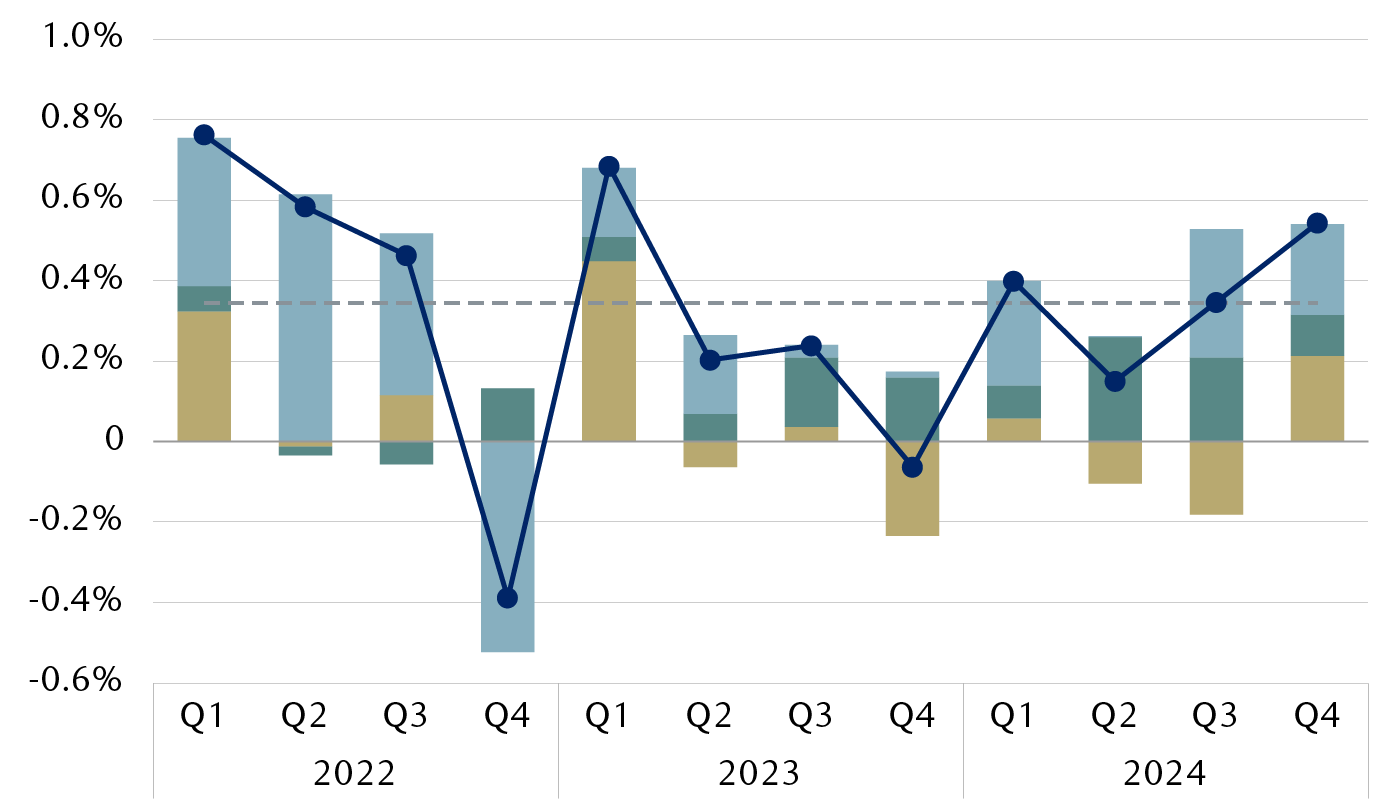
The graph shows a quarterly breakdown of European Union GDP since Q1
2022 and three major contributors to it: private consumption,
government consumption, and fixed investment. The data has been very
volatile over this period. Private consumption played a very modest
role from Q2 2023 to Q2 2024. Since Q3 2024, it has become a more
important driver of economic growth. In Q4 2024, all three
contributors had a positive impact on growth and since Q2 2024, the
economy has grown consistently quarter over quarter.
-
Private consumption
-
Government consumption
-
Fixed investment
-
Final domestic demand q/q
-
Long-term average demand
Note: Ireland excluded due to volatile data.
Source – RBC Wealth Management, RBC Capital Markets, Haver Analytics,
Eurostat
Germany’s fiscal package and the EU’s defense spending are also modest
tailwinds. RBC Capital Markets economists calculate that Germany’s
infrastructure spending, if ramped up over the next three years, could have a
growth impact of 0.5 percent of GDP per year for the country, or
0.15 percent for the euro area. The impact could be larger in the near
term if spending is front-loaded. Moreover, they estimate that increasing
the EU’s overall defense spending to three percent of GDP in 2030 from the
current 1.4 percent could have a direct impact of 0.3 percent per year on
real GDP growth, on average, by 2030. However, they concede that this is
an aggressive assumption, given that most Western militaries are already
suffering recruitment challenges even before any additional spending.
RBC Capital Markets recently increased its overall eurozone GDP growth
projections by approximately 0.5 percentage points per year, bringing
anticipated GDP growth to 1.9 percent in 2026 and 1.8 percent in 2027.
Tariff uncertainty continues
The clear risk to these estimates is a trade war. RBC Global Asset
Management Inc. Chief Economist Eric Lascelles maintains that the impact
of tariffs on European economies is “unlikely to be too painful,” because
unlike Canada and Mexico, Europe does not trade intensively enough with
the U.S. The ECB had calculated that a 25 percent blanket tariff could
crimp regional GDP growth by 0.3 percentage points over 12 months. Though
the tariffs imposed by the White House are a little lower, at 20 percent,
the impact on economic growth will depend on how long they are sustained,
how the EU responds, and how badly the new trade policies hurt business
and consumer confidence both in the region and globally.
Lascelles continues to believe that a deal will be struck eventually, and
that lower, partial tariffs will end up being imposed, much like during
the first Trump presidency—though this could take many months. In the
meantime, the economies of the largest European exporters to the U.S.
(including Germany and Italy) are likely to bear the brunt of impacts. The
effect on corporate earnings should be relatively limited given that many
companies have manufacturing operations in the U.S.
For now, we believe the new positive fiscal impulse in the euro area
should offset the negative tariff impact, though we acknowledge the risk
to growth may well be downwards.
Planning a new itinerary
The European Union’s structural issues, including a lack of investment by
Germany, have been a key reason for global investors’ caution towards the
European stock market. Recent developments suggest the bloc may be ready
to tackle those issues, acting with urgency and cohesion. Reflecting this
sentiment, markets have rallied year to date—but unbridled enthusiasm has
given way to skepticism about implementation. Very large stimulus programs
come with risks, including timing challenges and the potential for
misallocation of funds. Tariff worries are also weighing on regional
equities.
Nevertheless, we believe that on a 6-to-12-month horizon, a Market Weight
position in the region is now appropriate, up from an Underweight. This
new positioning better reflects the improved outlook, while acknowledging
that U.S. tariff developments could lead to volatility.
European equity valuations remain close to an all-time low relative to
U.S. and global peers on a sector-adjusted basis. In our view, being
selective and taking an active approach are crucial for this region, as it
provides a rich and varied opportunity set for stock selection. We believe
there are potential opportunities in Europe’s world-leading companies with
structural global tailwinds, particularly in Technology, Health Care, and
Industrials. We also see opportunities in niches exposed to the improving
domestic picture and to areas targeted by new fiscal policies, including
banks, defense, and capital goods.
With contributions from Thomas McGarrity, CFA
RBC Wealth Management, a division of RBC Capital Markets, LLC, registered investment adviser and Member NYSE/FINRA/SIPC.
Managing Director, Head of Investment Strategy
RBC Europe Limited
link