
The metallurgical coal industry operates within complex market dynamics where production decisions must balance operational economics with strategic asset preservation. When Coronado curtails production at US coal mine operations, it reflects sophisticated responses to market pressures that extend beyond simple supply-demand imbalances. This analytical framework examines how market forces drive strategic curtailment decisions and the risk management protocols that underpin such choices.
Cash flow preservation emerges as the primary driver when market conditions deteriorate beyond sustainable levels. Mining operations require continuous evaluation of their cost structures against prevailing commodity prices, with immediate action necessary when revenues fail to cover direct operating expenses. The decision matrix extends beyond simple profitability calculations to encompass liquidity management, contractual obligations, and optionality preservation for potential market recovery scenarios.
Strategic Mine Curtailment Decision Frameworks
Operational Economics and Threshold Analysis
Modern mining operations utilise sophisticated cash flow models that trigger production adjustments based on predetermined financial metrics. When operational cash costs exceed commodity pricing for extended periods, temporary curtailment becomes financially advantageous compared to sustained loss-making production. Furthermore, these decisions often coincide with broader coal supply challenges that affect entire regional markets.
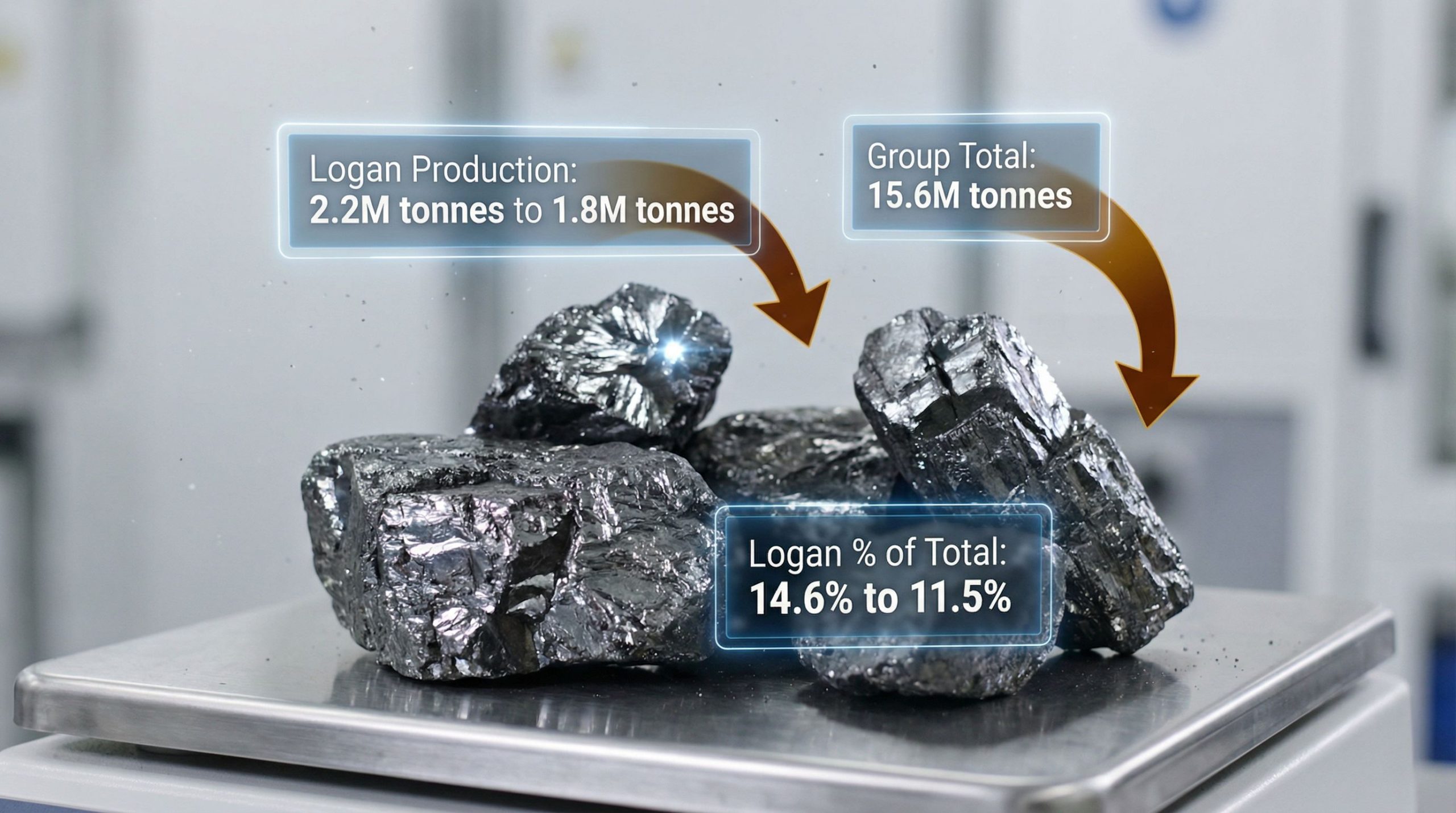
The Logan Complex in West Virginia exemplifies this strategic approach. Production declined 17% year-over-year in 2025, falling from approximately 2.2 million tonnes to 1.8 million tonnes. This reduction occurred as pricing fell below cash operating costs, creating unsustainable operational economics that necessitated immediate action.
Key threshold metrics include:
- Operating margin analysis: Direct comparison of cash costs versus realised pricing
- Liquidity burn rate calculations: Monthly cash consumption during loss-making operations
- Contract fulfilment economics: Profitability assessment of existing commitments
- Restart cost evaluations: Capital requirements for production resumption
Product Quality Differentiation and Market Positioning
The metallurgical coal market demonstrates significant quality-based segmentation, with high-volatile (high-vol) and mid-volatile (mid-vol) coal grades commanding different market positions and pricing structures. High-vol coals increasingly function as blend components rather than primary coking materials, fundamentally altering their demand profiles and pricing power.
This shift reflects evolving steel production methodologies where coke recipes increasingly favour mid-vol products for their superior coking characteristics. In addition, the ongoing evolution within industry innovation trends continues to reshape how coal grades are valued in global markets.
Technical specifications driving this differentiation include:
- Volatile matter content: High-vol typically contains 31-35% volatile matter versus 22-30% for mid-vol
- Coking strength: Mid-vol produces stronger coke structures in blast furnace applications
- Ash content variations: Quality parameters affecting steel production efficiency
- Sulfur levels: Environmental compliance requirements influencing selection criteria
Risk Management Protocols for Cyclical Mining Assets
Temporary Idling Versus Permanent Closure Analysis
Mining companies employ sophisticated decision frameworks when evaluating production curtailment options. Temporary idling preserves operational infrastructure whilst minimising cash consumption, maintaining the possibility of production restart when market conditions improve.
The Logan operation’s approach demonstrates strategic optionality preservation. Rather than pursuing permanent closure, the operation maintains basic infrastructure and regulatory compliance whilst fulfilling existing contractual commitments through March 2026. This strategy reflects management’s assessment that market recovery remains plausible within a defined timeframe, particularly given the complex tariff economic implications affecting global commodity flows.
The decision to temporarily idle rather than permanently close operations requires careful analysis of care-and-maintenance costs versus the value of preserving restart optionality.
Temporary Idling Considerations:
- Infrastructure preservation costs: Equipment maintenance and facility security
- Regulatory compliance obligations: Environmental monitoring and permit maintenance
- Workforce management: Skilled labour retention or retraining requirements
- Market timing assessments: Probability and timeline for price recovery
Financial Resilience and Liquidity Management
Effective risk management during market downturns requires comprehensive liquidity planning and debt covenant monitoring. Operations must maintain sufficient cash reserves to sustain temporary idling periods whilst preserving financial flexibility for eventual restart activities.
When Coronado curtails production at US coal mine facilities, the strategy prioritises cash preservation and shareholder value protection, indicating that operational losses posed unacceptable risks to overall corporate financial health. This approach reflects industry best practices where maintaining balance sheet strength takes precedence over production volume maintenance.
| Risk Management Metric | Assessment Framework | Strategic Importance |
|---|---|---|
| Monthly Cash Burn | Operating costs minus revenues | Liquidity runway calculation |
| Debt Service Coverage | EBITDA to interest expense ratio | Covenant compliance monitoring |
| Working Capital Management | Inventory and receivables optimisation | Cash flow acceleration |
| Restart Capital Requirements | Equipment and infrastructure investment | Optionality cost assessment |
Transportation and Logistics Cost Analysis
American metallurgical coal faces structural disadvantages in international markets, primarily driven by transportation economics and infrastructure constraints. The complex logistics chain from Appalachian mines to export terminals creates cost pressures that compromise competitiveness against Australian and Canadian alternatives.
Rail transportation from West Virginia coal fields to Hampton Roads or Baltimore port facilities represents a significant cost component, often exceeding $30-40 per tonne depending on fuel costs and rail capacity utilisation. However, these challenges are compounded by broader trade war market impact factors that influence international commodity flows.
International Market Share Erosion
US metallurgical coal exports have experienced systematic decline as international buyers increasingly favour Australian and Canadian suppliers. This shift reflects multiple competitive disadvantages including transportation costs, product quality consistency, and proximity to key Asian steel-producing regions.
The Logan operation, with its predominantly high-vol product mix, faces particular exposure to these market dynamics. High-vol coal’s reduced utility as primary coke feed limits export opportunities, as international buyers increasingly specify mid-vol products for direct coking applications, according to Argus Media’s latest market analysis.
Export Market Challenges:
- Geographic disadvantage: Distance to Asian steel mills increases transportation costs
- Product specification preferences: International buyers favour mid-vol over high-vol coal
- Currency impacts: USD strength affects export pricing competitiveness
- Trade relationship complexities: Political factors influencing market access
What Impact Does Electric Arc Furnace Adoption Have on Coal Demand?
The global steel industry’s gradual shift toward electric arc furnace (EAF) technology represents a fundamental threat to metallurgical coal demand. EAF steel production utilises recycled steel scrap as primary feedstock, eliminating the need for coking coal entirely.
Whilst blast furnace steelmaking will remain important for decades, particularly for flat-rolled steel products, EAF capacity expansion reduces total coking coal consumption per tonne of steel produced. This trend particularly affects high-vol coal demand, as EAF operations require no metallurgical coal inputs.
Current industry estimates suggest EAF steel production accounts for approximately 70% of US steel output, with continuing expansion planned. Each percentage point increase in EAF market share corresponds to reduced metallurgical coal demand, creating structural headwinds for coal producers. Furthermore, companies must implement comprehensive market volatility hedging strategies to manage these transition risks.
Alternative Steelmaking Technology Development
Emerging steelmaking technologies pose longer-term risks to metallurgical coal demand, although commercial deployment remains years away. Hydrogen-based direct reduction processes and other alternative approaches could eventually reduce blast furnace utilisation in favour of lower-carbon steel production methods.
These technological developments, whilst not immediately threatening current operations, influence long-term investment planning and asset valuation frameworks. Mining companies must consider technology transition risks when evaluating capital deployment and operational life extension decisions.
Regional Mining Ecosystem Impacts
West Virginia Coal Industry Infrastructure
The Logan curtailment affects broader regional infrastructure utilisation, including rail networks, port facilities, and service provider ecosystems. West Virginia’s coal mining infrastructure was developed to support higher production volumes, creating excess capacity when individual operations reduce output.
This infrastructure overcapacity creates both challenges and opportunities. Reduced coal volumes decrease rail and port utilisation rates, potentially increasing per-unit transportation costs for remaining producers. However, excess capacity also provides flexibility for production expansion if market conditions improve.
Workforce and Community Effects
Mining operation curtailments create cascading employment effects throughout local communities. Direct mining employment reductions impact service providers, equipment suppliers, and local businesses dependent on mining industry wages.
The Logan operation’s workforce management strategy during temporary idling affects regional labour markets. Skilled mining professionals may migrate to other regions or industries, potentially creating workforce availability challenges if production restart becomes viable. Recent reports indicate that several mining operations across southern West Virginia face similar workforce transitions.
Market Recovery Scenarios and Restart Readiness
Price Recovery Threshold Analysis
Production restart decisions depend on sustained price improvements that restore positive operating margins. Market analysis suggests metallurgical coal prices must exceed cash operating costs by sufficient margins to justify restart capital expenditure and working capital investment.
The Logan operation’s restart threshold likely requires high-vol coal pricing to recover to levels providing positive cash margins plus adequate returns on restart investment. This calculation includes equipment recommissioning costs, workforce rehabilitation, and working capital requirements for renewed production.
Infrastructure and Operational Readiness
Successful production restart requires comprehensive infrastructure assessment and equipment verification. Mine ventilation systems, processing equipment, and transportation infrastructure must undergo thorough inspection and potential refurbishment before production resumption.
Regulatory compliance represents another restart requirement, including permit reactivation, safety inspections, and environmental monitoring system verification. These processes can require several months, making immediate production restart impossible even when market conditions improve.
Restart Readiness Checklist:
- Equipment condition assessment: Mechanical systems evaluation and refurbishment
- Regulatory permit reactivation: Safety and environmental compliance verification
- Workforce recruitment and training: Skilled labour availability and certification
- Supply chain reestablishment: Vendor relationships and service provider coordination
Investment Implications for Coal Sector Positioning
Portfolio Risk Assessment Framework
When Coronado curtails production at US coal mine operations, it demonstrates the importance of operational diversification and geographic risk management in coal sector investments. Companies with concentrated exposure to specific coal grades or geographic regions face heightened vulnerability during market downturns.
Coronado’s operational portfolio includes 15.6 million tonnes of total production capacity, with Logan representing approximately 11.5% of total output. This diversification provides operational flexibility, allowing the company to curtail underperforming assets whilst maintaining production from more profitable operations.
Long-Term Sector Trajectory Considerations
Coal sector investments must account for structural demand trends and technology transition risks. The Logan situation exemplifies how specific coal grades face differentiated market pressure, with high-vol coals experiencing more severe challenges than mid-vol alternatives.
Investment strategies require careful consideration of:
- Product mix optimisation: Focus on coal grades with stronger demand fundamentals
- Geographic diversification: Balanced exposure across different mining regions
- Operational scale advantages: Larger operations better positioned to weather market cycles
- Financial flexibility maintenance: Adequate liquidity for cyclical downturns
Conclusion: Strategic Adaptation in Evolving Markets
The metallurgical coal industry’s evolution requires sophisticated risk management and strategic planning. Operations like Logan demonstrate how market-driven curtailment decisions reflect broader structural changes in steel production and global commodity trade patterns.
Consequently, when Coronado curtails production at US coal mine facilities, these decisions serve as indicators of broader industry transformation. Companies that successfully navigate these challenges will be those that maintain operational flexibility, preserve financial strength, and adapt to evolving market conditions whilst preserving optionality for future opportunities.
Disclaimer: This analysis is based on publicly available information and industry assessments. Coal market dynamics involve significant uncertainty, and operational decisions depend on company-specific factors and market conditions that may change rapidly. Investors should conduct independent research and consult qualified professionals before making investment decisions.
Are You Tracking High-Impact Mining Announcements for Investment Opportunities?
Discovery Alert’s proprietary Discovery IQ model delivers instant notifications on significant ASX mineral discoveries, transforming complex mining data into actionable investment insights for both short-term traders and long-term investors. Explore how major discoveries have historically generated substantial market returns and begin your 14-day free trial today to position yourself ahead of market movements.
link