

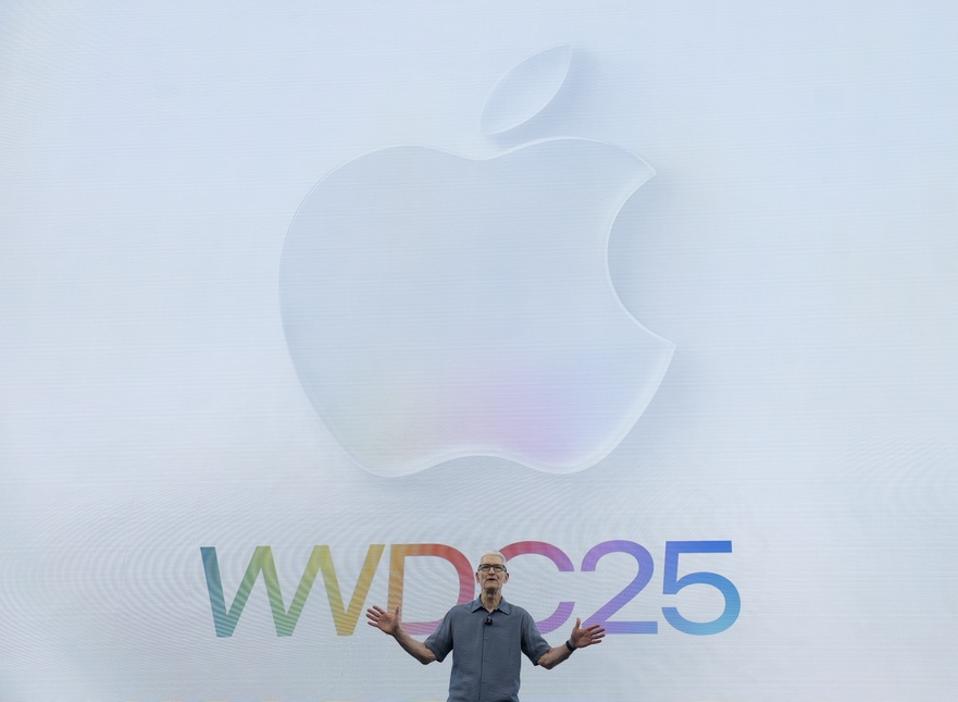
CUPERTINO, CALIFORNIA – JUNE 09: Apple CEO Tim Cook speaks during the Apple Worldwide Developers Conference (WWDC) on June 09, 2025 in Cupertino, California. Cook kicked off the annual Apple WWDC conference, which runs through June 13. Apple is expected to announce design and fuctionality updates to the operating system of its various products. (Photo by Justin Sullivan/Getty Images)
Getty Images
At Apple’s Worldwide Developers Conference, the company unveiled its long-awaited artificial intelligence strategy: system-wide writing and communication tools, photo-based visual intelligence, and a developer-ready on-device language model. Coverage from the Wall Street Journal and Bloomberg described the rollout as restrained compared to competitors, cautious where others were bold.
That restraint is the wake-up call. The Associated Press described the updates as incremental, noting that many of the functions Apple introduced already exist on rival platforms. This reaction highlights a larger reality: AI features will spread quickly across the industry and cannot define long-term advantage.
Research points to the scale of that opportunity. McKinsey estimates that generative AI could automate activities accounting for 60-70% of employees’ time. Deloitte’s Generative AI survey found that most executives prioritize efficiency and cost savings when planning AI adoption, although the same survey also noted that organizations value customer experience and growth. That gap highlights the opportunity to use freed-up capacity for higher-value work.
Why The Future Of Work Is Not Just Swapping Human Transactions For Automated Systems
AI is well-suited to routine, rules-based activities such as summarizing documents or scheduling tasks. This is what managers should focus on when evaluating employee performance in the age of AI.
Capturing that opportunity requires leadership decisions. Employees must be placed in roles that emphasize judgment, empathy, and creativity, rather than merely replacing the tasks that automation removes. Stretch goals should measure outcomes such as new revenue streams or stronger customer loyalty, not only cost savings.
Apple’s cautious rollout emphasized integration over spectacle, underscoring that AI is most powerful when it enables people to do more. The risk of overlooking that human dimension has been evident for years. In 2018, PwC found that while 73% of customers said experience influenced purchasing decisions, only 10% of companies prioritized it digitally. That blind spot persists. Salesforce’s “State of the Connected Customer” report shows that 80% of customers now rate experience as equal in importance to products themselves, yet many leaders still channel AI gains primarily into efficiency.
The same principle applies to innovation. McKinsey research published in February underscores that top performers extend their lead not by cutting costs, but by leveraging innovation to strengthen their core business and expand into new markets, especially when they direct talent toward higher-value problems.
How Leaders Can Shift Their Mindsets
- Shift from efficiency to expansion. Utilize AI’s time advantage to accelerate key objectives, such as faster product launches and new market entry.
- Deploy talent to the front lines of growth. Place people where connection, creativity, and insight create true advantage.
- Elevate contribution beyond tasks. Reward ideas, collaboration, and judgment, not just completed checklists.
The AI race is not about squeezing out more efficiency. That contest ends in a draw. Apple’s measured rollout underscored the point: the future of work will not be won by the flashiest features, but by leaders who redefine human contribution.
Across studies, a consistent pattern is emerging. Organizations that apply AI primarily to cut costs are already seeing diminishing returns, while those that reinvest efficiency gains into innovation and growth are widening their lead. As automation scales, differentiation will hinge on how effectively leaders channel human insight, creativity, and connection into new value. The next phase of competitive advantage will come from using AI as a catalyst for expansion, turning freed capacity into innovation, stronger customer relationships, and sustained performance. That shift is already underway, even as adoption data shows most organizations are still directing AI gains toward efficiency rather than growth.
link