
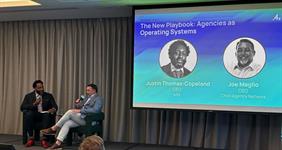
Strategy is a key part of the advertising and marketing ecosystem, and the practice has risen in prominence within the industry in the past few years. At this year’s StratFest, 4As’ yearly gathering of agency and brand strategists, Justin Thomas-Copeland, who was named CEO of the American Association of Advertising Agencies (4As) in May, gave strategists advice on how to navigate a rapidly changing landscape, adapt faster than the forces reshaping our industry, such as AI, and quicker turnaround times.
The rather ominous theme of StratFest was “Adapt or Die,” and Thomas-Copeland states the event was a great way for the strategy community to come together, so everyone feels like they’re in the same boat and rowing in the right direction.
Thomas-Copeland said that strategy should be at the center of the marketing equation because it provides insights for great work, as well as helps clients make sense of business challenges.
“I believe in strategy being front of house with clients. I’m a believer in total client leadership, which means that everyone plays a front-line position. And now more than ever, given the disruption of the industry itself, and then given the macro-economic challenges that clients are going through, where they’re having to look at supply chain, crisis strategies, market share, market shifts, strategy’s got a lot of value to bring to the table,” said Thomas-Copeland, who came to the 4As from DDB North America.
Thomas-Copeland said clients want converged thinking, especially because the world we live in is a converged one.
“Clients are looking for converged solutions, agency partners who can think breadth and depth. And I’ve always felt that you’ve got to converge your teams. You’ve got to put people together in different ways,” explained Thomas-Copeland.
Strategy is the mayonnaise
During the Jay Chiat Awards ceremony the night prior, which celebrates strategic campaigns, the emcee posed a question to the audience, referencing the award-winning Mayo Cat: How Hellmann’s Turned Leftovers Into A Brand Transformation Story campaign: “Who’s the mayonnaise in your team?” meaning “who’s holding the team together?”
“You put bacon and lettuce between two bits of bread, it’s not that great. Put a little bit of mayonnaise and it transforms. Strategy is the mayonnaise, the glue, it’s what holds it together,” said Thomas-Copeland.
What is the new agency relationship?
“Where can agencies provide value in our changing world?” That was a question posed during a fireside chat between Thomas-Copeland and Joe Maglio, CEO, Cheil Agency Network. Maglio said that’s what clients are wondering right now, and agencies need to define it before clients define it for them.
According to Maglio, strategy is the answer. He called strategy the “tip of the spear,” because strategists have to understand a client’s business as well as understanding the consumer. Clients, he said, tend to have a myopic view of who they’re speaking to, because they’re selling certain products or services and they get really deep into that aspect. But the great part about agencies is they can go broad.
“I go into every pitch and say, ‘We don’t know your business as well as you do…but we know the people who are buying your product better than you do,’ and that’s because we are taking a view of that audience across what they do in their lived experience, across all the different products they’re buying,” said Maglio.
Maglio said that strategy is not just writing a creative brief anymore; it’s understanding how people move through the world.
“It’s almost becoming more anthropological than it’s ever been. AI data is not going to replace a strategist at an agency really helping a client understand what they need to do across their entire ecosystem of touch points to help drive engagement and ultimately sales,” explained Maglio.
AI is a tool that needs both attention and caution. Maglio noted that he created an experiment where he asked ChatGPT to give him notes about social commerce, and then he asked a strategy team at one of the Cheil agencies to do the same thing. The strategists did it in about a week, while it only took 20 minutes in ChatGPT deep research. The strategists’ results were within plus or minus 10% of what ChatGPT did in 20 minutes.
“That doesn’t mean the strategists shouldn’t be there. It just means ‘how are you using your time to contribute?’” said Maglio. “The way to protect strategists is an understanding of that lived experience of the people who you are engaging. You can’t really get that through ChatGPT prompting.”
After Thomas-Copeland pointed out that strategists need to have multiple skills to succeed, Maglio stated that a really good strategist needs to be curious.
“We do have to bring in training, different learning and development modules, and probably spend more money on it. But you also need people who are curious, because the people who are the most curious, they’re going to be self-taught, they’re going to knock everyone else to the side, and they’re going to stand up as the people in the room who are going to take the agency and then ultimately the client’s business forward,” said Maglio.
link